
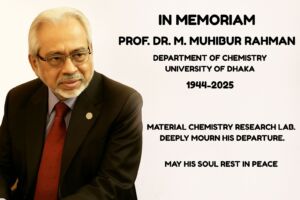
With profound sadness – we announce the passing of Professor Dr. M. Muhibur Rahman, an eminent chemist, revered educator and a dedicated researcher who left us on 30 March 2025 at the age of 81 after a life of illustrious academic careers, research activities, and scientific contributions. A towering figure in the field of Physical and Atmospheric Chemistry in Bangladesh, Professor Rahman leaves behind a legacy of research excellence, pedagogical rigor, and institutional developments. He was an extraordinarily productive, imaginative and a dedicated scientist.
Professor Rahman began his illustrious teaching career in the Department of Chemistry, University of Dhaka in 1966 as a Lecturer and appointed as Assistant Professor in 1971, Associate Professor in 1974 and Professor in 1987 in the same department. Professor Rahman remained with the Department of Chemistry for more than four decades until his retirement in 2010. His career continued even after retirement — as a UGC Professor (2017–2019) and through major national education initiatives, including the Higher Education Quality Enhancement Project (HEQEP) under the Ministry of Education.
Professor Rahman was born on 2nd January, 1944 in the village Manikpur of Zakiganj Upazila in the district of Sylhet. His academic brilliance became evident early. He had Basic Islamic education in the village masjid in early childhood; Primary Education: Manikpur Primary School, 1949-1953; Secondary education: Zakiganj Government High School, 1954-1959 and passed the Matriculation Examination of the then East Pakistan Secondary Education Board in 1959, securing 16th place in order of merit. He had Higher Secondary Education from Dhaka College, Dhaka (1959-1961), and passed I.Sc. examination of the Dhaka University in the Science group in 1961, securing Second place in order of merit. For tertiary level education, he studied in the Department of Chemistry, Dhaka University (1961-1965) and obtained the B.Sc. (Honours in Chemistry) degree in 1964 and M.Sc. (Chemistry) degree in 1965, securing first position in First Class in both. He had higher studies in the Department of Physical Chemistry, Cambridge University, UK from 1967-1970 and obtained the Ph.D. Degree in 1970 under the supervision of Professor J. W. Linnett, FRS, as a Commonwealth Scholar.
He received first grade merit scholarship during higher secondary and tertiary level studies; Commonwealth scholarship for doctoral studies in Cambridge University, UK; Alexander von Humboldt Fellowship for postdoctoral research in the Goettingen University (1974-1976) and Kiel University (1984); British Council Senior Visitorship for research in the University of East Anglia, Norwich, England (1984); Guest Scientist in Goettingen University, Germany (1976-1977), Kiel University, Germany (1984-1987, 1990-1992, 1994-1995); for teaching and research; Specially invited research scientist of the Alexander von Humboldt Foundation to work on atmospheric chemistry in the Wuppertal University, Germany (September 2012 and October 2013).
A gifted teacher and mentor, Professor Rahman trained and supervised over 90 postgraduate research students, including Ph.D. and M.Phil. candidates in the Department of Chemistry, Dhaka University. He also co-supervised two PhD students in the Institute of Physical Chemistry, University of Kiel, Germany. His former students now hold -important academic and scientific positions around the world. His lectures in physical chemistry, spectroscopy, quantum mechanics and surface chemistry were known for their clarity, intellectual depth, and uncompromising emphasis on scientific discipline. He inspired generations of chemists with his uncompromising commitment to laboratory precisions, academic integrity, and the scientific method. He was a perfectionist.
Prof. Rahman imparted his knowledge to many generations of students, guiding them through the complexities of physical chemistry. His gentle demeanor and steadfast, principled judgment earned him deep respect from his students and colleagues alike. He had the exceptional passion for learning and ability to inspire others. His contributions to research were both foundational and wide-ranging. He carried out research in Dhaka University on solid state chemistry, adsorption on solid surfaces from gas phase and aqueous phase; kinetics of reactions in solution, oxidative destructive of gaseous pollutants on solid catalysts, micellar catalysis, use of micelles as nano-reactors for synthesis of nanoparticles. Professor Rahman was among the pioneers of Atmospheric Chemistry and Catalysis research in Bangladesh. He introduced and led research in the fields such as heterogeneous catalysis, reaction kinetics, nanomaterials, and monitoring atmospheric pollution. As the Director (2009-2010) of the Centre for Advanced Research in Sciences (CARS), Dhaka University, he established first Air Quality Monitoring Centre of the country and opened the facilities to a wide range of faculty and students, fostering interdisciplinary collaborations. Prof. Rahman was a highly valued collaborator and mentor, with collaborations spanning across the Globe. He will be remembered as an outstanding leader in his field who created a collegial environment where researchers could share ideas and learn from each other, and it is through all these people that his work and values will be -carried on.
Prof. Rahman’s contributions to Chemistry were not limited to research and academic leadership. His involvement in popularizing science, development of curriculum, and self-assessment left an indelible mark on Education. Known for his lively and inquisitive lecturing style, he challenged his audiences with thought-provoking questions, constantly reminding his students and colleagues that, while we may know much, there is always more to discover.
His international engagements included extended research stays in Germany, particularly at the Universities of Göttingen, Kiel, and Wuppertal, under prestigious fellowships such as those from the Alexander von Humboldt Foundation and the German Research Society. In Cambridge University, he Worked on Mössbauer spectroscopic studies of ferrites and heterogeneous gaseous reactions on solid catalysts with Professor J W Linnett, FRS, while in Goettingen University he focused on photoelectric properties of metal oxides, heterogeneous catalysis while working with Professor Karl Hauffe. In University of East Anglia, Norwich, UK he worked on Infrared spectra of adsorbed species with Professor Norman Sheppard, FRS and in University of Kiel, Germany his areas of interests were kinetics of elementary reactions of gaseous species relevant to atmospheric chemistry with Professor R. N Schindler and in Wuppertal University, Germany, he engaged himself with detection of atmospheric pollutants with Professor Thorsten Benter. He was fluent in German, Bengali, English, and conversant in several other languages, which enriched his capacity for cross-cultural academic exchange. He visited UK and Germany for research stays, USA, Canada, Italy, Estonia, Pakistan, India, Sri Lanka, Thailand, Malaysia, Hong Kong, China, Japan for academic visits.
Professor Rahman was a founder member of several major scientific organizations in Bangladesh, including the Bangladesh Chemical Society, which he served as President (2007–2010), and the Association of Humboldt Fellows Bangladesh (AHFB), where he served both as long-time General Secretary (1983-2003) and later as President (2003-2010). As a President of Bangladesh Chemical Society, he made remarkable contributions to brighten the image of the Society internationally. He took initiatives to award Honorary Fellowships to several chemists of international standing including Nobel Laureate Yuan Tseh Lee of Taiwan and IUPAC President Jung Ill Jin of South Korea. He made remarkable contributions to Bangladesh- Germany academic and cultural ties. His editorial leadership spanned the Dhaka University Journal of Science and the Journal of the Bangladesh Academy of Sciences, contributing to the national discourse on scientific publication standards.
He was deeply respected as an academic administrator, having served as Chairman of the Department of Chemistry (1996–1999) and House Tutor at Shahidullah Hall (1977–1983). He was member, University Grants Commission of Bangladesh (2010–2014) and played a key role in reforming the policies of awarding research grants, UGC Awards for best research publications to faculty members in universities; in implementing the Higher Education Quality Enhancement Project of the Ministry of Education, Government of Bangladesh and introducing a mechanism of Quality Assurance of Higher Education (IQAC)in the universities in Bangladesh. His leadership style was marked by fairness, institutional loyalty, and -enviable commitment to academic merits.
A prolific author, Professor Rahman published 95 peer-reviewed journal articles and several book chapters, including a Text Book on Higher Secondary level chemistry that continue to guide chemistry students across the country. He was a pioneer in launching the Bangladesh Chemistry Olympiad, fostering a culture of scientific curiosity among high school students.
Professor Rahman is survived by Mrs. Shamim Rahman, four daughters: Dr. Luna Nasrin Rahman is a Senior Biologist in Health Canada, Ottawa, Canada; Fiona Tasnim Rahman is a seasonal lecturer in Economics in the University of Waterloo, Canada, Dr. Monica Sharfin Rahman is a Visiting Assistant Professor in the Miami University Oxford, USA and Dr. Anika Tahsin Rahman, MS in Biochemistry and Molecular Biology from Dhaka University and PhD in Biochemistry, Hokkaido University, Japan. Just completed a Post-doctoral Fellowship in the University of Edmonton, Alberta, Canada. His absence leaves an irreplaceable void in the scientific and academic community of Bangladesh.
Prof. Dr. M. Muhibur Rahman was a formidable intellectual, with an acute critical eye and acerbic wit, and he is remembered by those he had taught and those whose research he had supervised, as a generous, thoughtful and inspiring teacher, and an original and international agenda-setting academic. The Bangladesh Academy of Sciences, the University of Dhaka, and the wider scientific world will long remember Professor Rahman, a man of impeccable integrity and undisputed honesty, for his scholarship, mentorship, and unwavering dedication to the pursuit of knowledge and will always treasure his academic and scientific contributions.

Leave A Comment